
SpaceX’s Fram2 Mission Opens a New Frontier Over Earth’s Poles
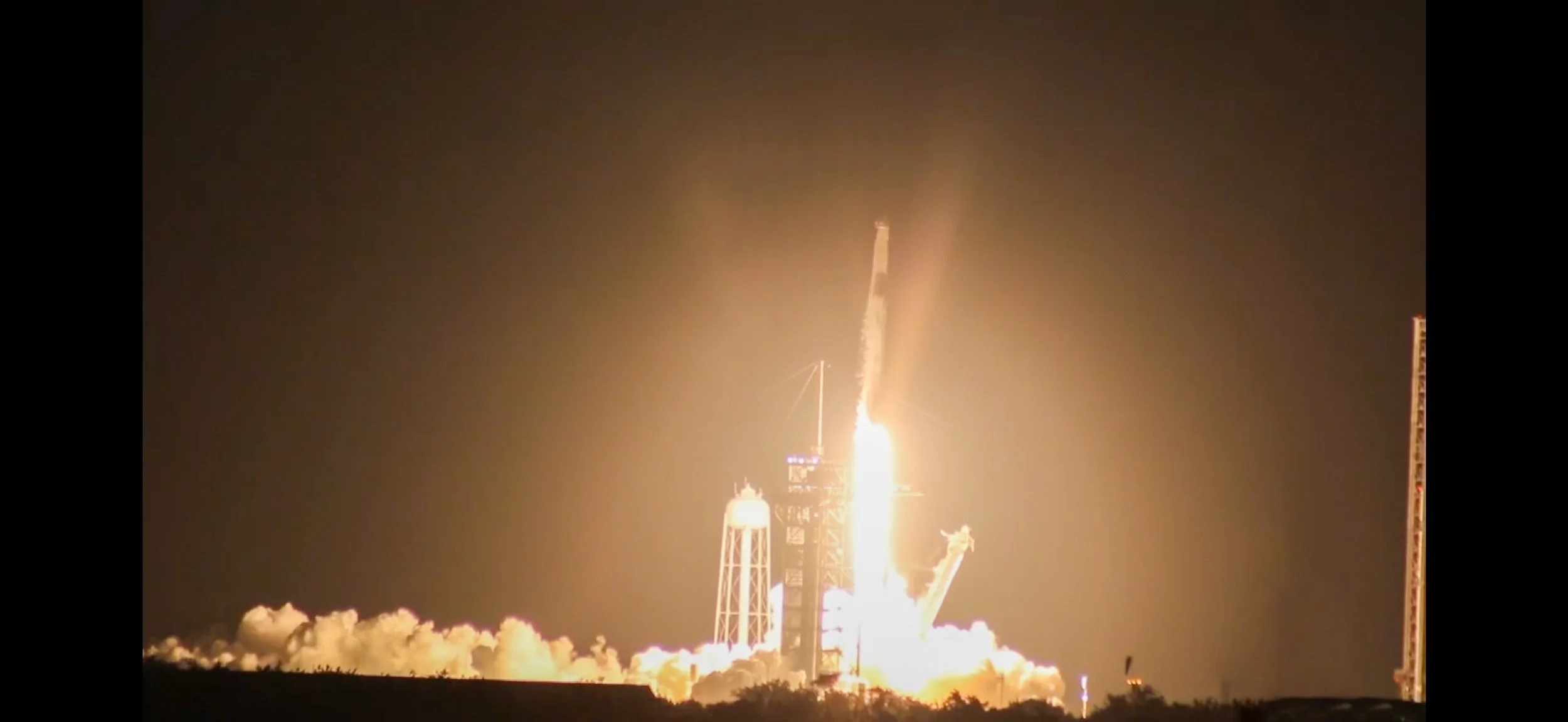
Photo: Shot by Florida Spaceflight. Liftoff of the FRAM 2 Mission
Kennedy Space Center, FL., (March 31st, 2025)- In what may be one of the most significant milestones in human space exploration this decade, SpaceX successfully launched the Fram2 mission late Monday night, sending the first crew of private astronauts into a polar orbit around Earth — a trajectory that has never before been achieved by humans.
The 9:46 p.m. EDT liftoff from NASA’s iconic Launch Complex 39A saw SpaceX’s Falcon 9 booster roar into the night sky, piercing storm-lit clouds as the Crew Dragon spacecraft Resilience carried four civilian crew members toward a 90-degree orbital inclination that will carry them directly over both the North and South Poles.
The Fram2 crew — commanded and funded by entrepreneur Chun Wang, alongside Jannicke Mikkelsen, Rabea Rogge and Eric Philips — represents a new chapter in space access. None of the four have traditional astronaut credentials, marking a clear shift toward broader participation in orbital missions.
“Tonight’s success is not just about breaking a record,” Wang said in a pre-launch briefing. “It’s about expanding the realm of possibility for human spaceflight and allowing people from all walks of life to see our planet from the most remote vantage points.”
A New View of Our World
From the capsule’s panoramic cupola, the crew will capture and transmit the first human views of Earth’s poles from space. The mission will conduct a suite of scientific and exploratory tasks over three to five days, including auroral photography, compact exercise science for future spacecraft design, and pioneering medical imaging experiments such as X-rays in microgravity — a first for an orbital mission.
Those experiments are not merely symbolic. They reflect a growing recognition that understanding how human physiology responds to microgravity — especially tasks once reserved for highly trained professionals — will be indispensable as commercial and long-duration missions continue to expand.
For aviation and spaceflight observers, the polar orbit itself is a feat of engineering and trajectory design. Unlike more common equatorial or mid-inclination orbits, this 90-degree path required precise ascent planning and presented unique challenges in weather forecasting across both the launch corridor and recovery zones.
Redefining Who “Gets to Go”
The composition of the Fram2 crew stands in stark contrast to the early decades of human spaceflight, when astronauts were exclusively military aviators or scientists with extensive training. Here, a polar guide, a film professional, and novice explorers join an entrepreneur in a flight that could signal a broader democratization of access to orbit — so long as funding and training pipelines continue to evolve.
Critics may argue that private missions are emblematic of spaceflight becoming a playground for the wealthy. Yet regardless of motivation, the data gleaned and images returned from this first polar orbit will enrich scientific understanding and public appreciation of Earth’s most remote regions.
Looking Ahead
As Fram2 settles into its historic orbit and begins its observational campaign, the space industry will be watching closely. This mission stands as both a technological milestone and a cultural signal — one that suggests the boundary between professional astronaut and private citizen is becoming increasingly permeable.
It is too soon to predict the long-term legacy of Fram2, but for now, it has unquestionably expanded the horizon of human experience: not just reaching space, but doing so in a way that allows us to see all of Earth, from pole to pole, through new eyes.