
NASA selects ULA’s Centaur V as new upper stage for Space Launch System
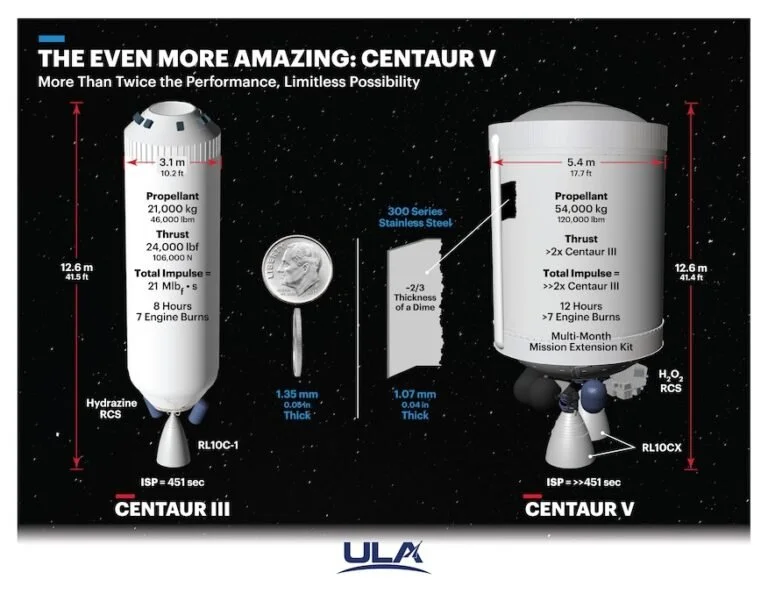
Image: ULA
CAPE CANAVERAL, FL. (March 7th, 2028) — NASA has confirmed it will use United Launch Alliance’s Centaur V upper stage for future flights of the Space Launch System rocket, beginning with the Artemis IV mission planned for 2028.
The decision, outlined in recently released procurement documents, formalizes a shift in NASA’s strategy for the agency’s heavy-lift rocket as it looks to simplify the vehicle’s architecture and reduce costs and schedule risk within the Artemis lunar program.
Centaur V, developed by United Launch Alliance (ULA) for its Vulcan rocket, will replace the previously planned Exploration Upper Stage (EUS), a large hydrogen-fueled stage that had been under development by Boeing for use on upgraded versions of SLS.
Moving away from the Exploration Upper Stage
Under the original plan for the Artemis program, the first three SLS launches would use an Interim Cryogenic Propulsion Stage (ICPS), a modified version of the Delta IV second stage, before transitioning to the more powerful Exploration Upper Stage starting with Artemis IV.
However, the EUS program experienced years of delays and escalating costs. Delivery of the first flight unit had slipped to 2027, raising concerns about the schedule for later Artemis missions.
In February, NASA leadership announced plans to standardize the SLS fleet around a simpler configuration, abandoning the Block 1B upgrade that would have required the Exploration Upper Stage. Instead, the agency began evaluating commercially developed upper stages that could integrate with existing launch infrastructure.
Centaur V ultimately emerged as the preferred solution.
NASA’s procurement justification notes that the stage can interface with the current Mobile Launcher 1 platform and existing liquid oxygen and liquid hydrogen systems at Kennedy Space Center with relatively minor modifications.
The agency also cited the long heritage of the RL10 engine family and ULA’s experience working with NASA launch infrastructure as factors in the selection.
Image: ULA
A commercially developed stage
Centaur V is the upper stage used on ULA’s Vulcan rocket, which debuted in 2024. The stage uses two RL10 engines and is designed to deliver greater performance and endurance than earlier Centaur variants.
Because the stage is already in operational service on Vulcan launches, NASA expects the approach will reduce development time compared with completing an entirely new upper stage program.
NASA plans to procure the hardware through a sole-source contract with ULA, citing the specialized nature of the system and the timeline required to support upcoming Artemis missions.
Officials say selecting an existing stage also allows NASA to leverage established manufacturing lines and infrastructure, which could help improve the overall flight rate of the SLS rocket.
Implications for Artemis
The change will first affect Artemis IV, currently targeted for launch no earlier than 2028 from Launch Complex 39B at Kennedy Space Center.
That mission is expected to send four astronauts aboard an Orion spacecraft on a journey to lunar orbit as part of NASA’s broader effort to establish a sustained human presence near and on the Moon.
Artemis IV will follow Artemis II, the first crewed SLS mission planned to orbit the Moon, and Artemis III, which is intended to test key elements of the lunar landing architecture.
NASA’s shift to Centaur V also reflects broader changes underway across the Artemis program as the agency seeks to streamline systems and accelerate mission cadence while controlling costs.
Looking ahead
Work will now focus on integrating the Centaur V stage with the Space Launch System and modifying ground systems at Kennedy Space Center where necessary.
Engineers will need to update upper-stage interfaces, fueling connections, and avionics systems before the configuration can be certified for flight.
If the integration effort proceeds on schedule, the new stage will become a key component of the Artemis missions planned for the late 2020s, supporting NASA’s long-term goal of returning astronauts to the lunar surface and establishing a sustained presence around the Moon.