
Artemis II Crew Returns to Earth, Completing First Crewed Lunar Mission Since Apollo
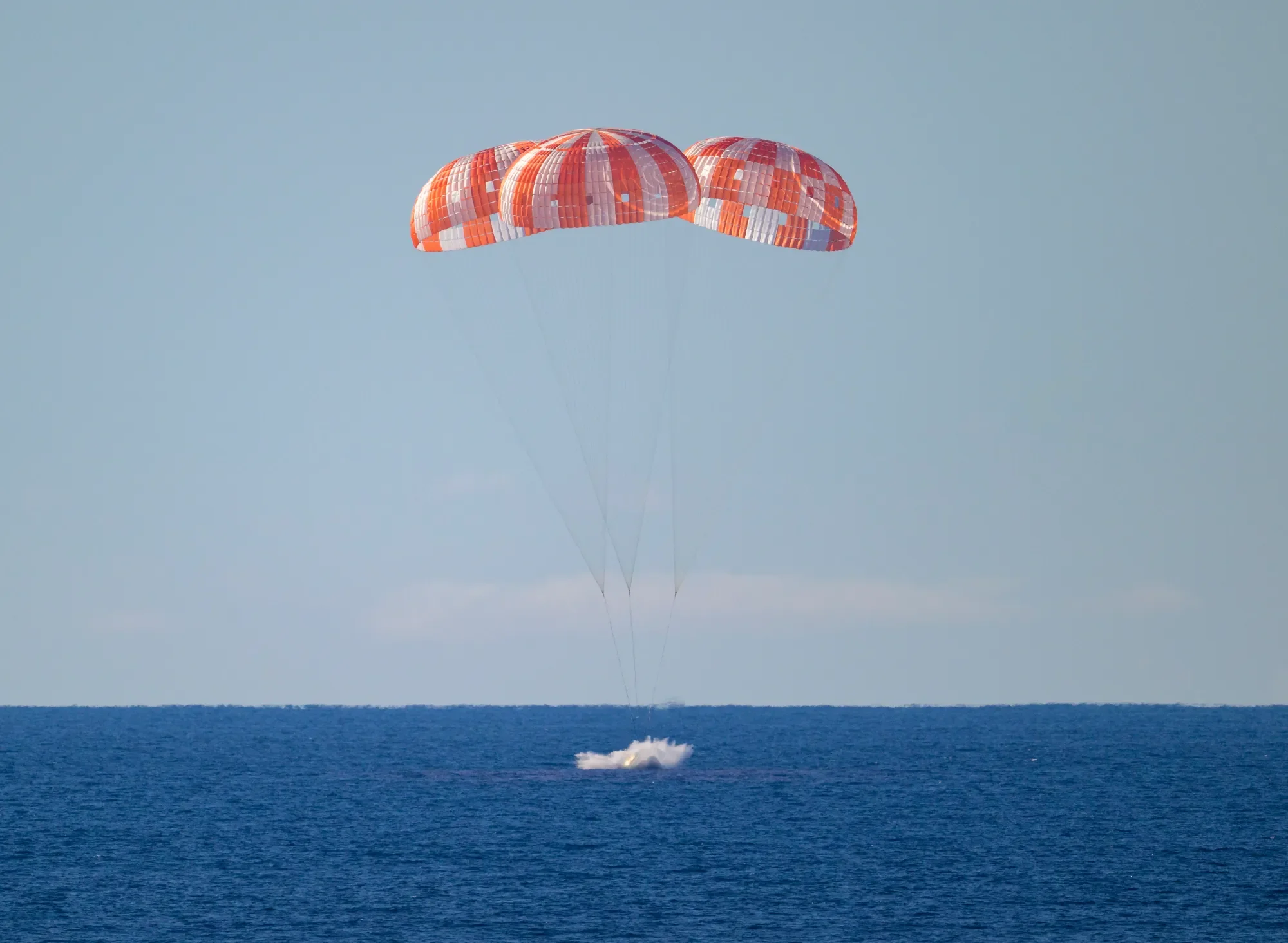
NASA’s Orion spacecraft with Artemis II crewmembers NASA astronauts Reid Wiseman, commander; Victor Glover, pilot; Christina Koch, mission specialist; and CSA (Canadian Space Agency) astronaut Jeremy Hansen, mission specialist aboard is seen as it lands in the Pacific Ocean off the coast of California, Friday, April 10, 2026 at 8:07 p.m. EDT. NASA’s Artemis II mission took Wiseman, Glover, Koch, and Hansen on a nearly 10-day journey around the Moon and back to Earth. Following a splashdown at , NASA, U.S. Navy, and U.S. Air Force teams are working to bring the crewmembers and Orion spacecraft aboard USS John P. Murtha.
NASA/Bill Ingalls
Cape Canaveral, Florida — NASA has successfully returned the four astronauts of its Artemis II mission to Earth, marking the completion of the first crewed journey around the Moon in more than 50 years. The crew splashed down in the Pacific Ocean off the coast of San Diego, California, bringing an end to a multi-day test flight that validated key systems for future deep space missions.
The astronauts traveled aboard the Orion spacecraft, which reentered Earth’s atmosphere at speeds approaching 25,000 miles per hour before deploying parachutes and descending to a controlled ocean landing. Recovery forces, led by the U.S. Navy in coordination with NASA, secured the capsule and crew shortly after splashdown.
The return caps a mission that sent humans beyond low Earth orbit for the first time since the Apollo era. Artemis II followed a free-return trajectory around the Moon, carrying the crew thousands of miles beyond the lunar far side before looping back toward Earth. The flight built on the uncrewed Artemis I mission, which tested the performance of NASA’s deep space systems without astronauts onboard.
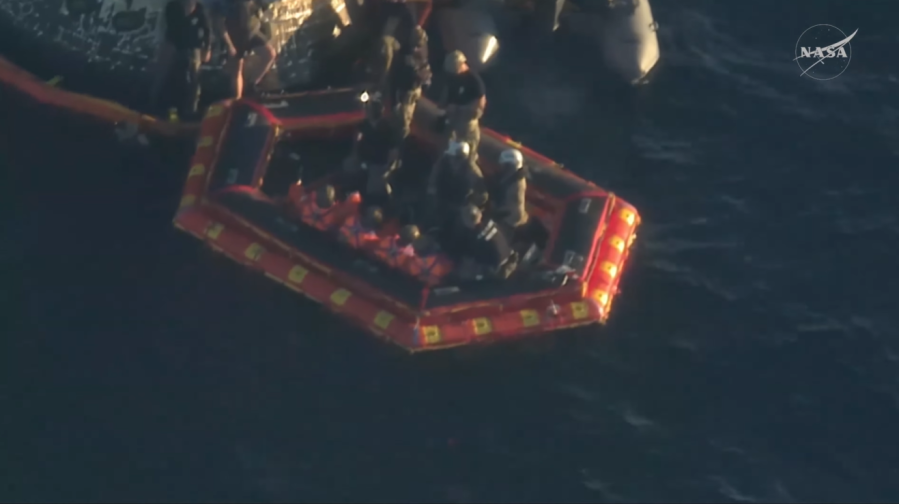
The Artemis II crew is seen on an inflatable raft, called the front porch, after exiting the spacecraft. The Artemis II mission successfully splashed down in the Pacific Ocean at 8:07 p.m. EDT on April 10, 2026.
NASA
During reentry, Orion executed a skip-entry profile designed to manage the extreme heat and forces associated with returning from lunar distances. The spacecraft’s heat shield, the largest ever developed for human spaceflight, endured temperatures of roughly 5,000 degrees Fahrenheit. Engineers will now analyze performance data to assess how the system behaved under real flight conditions.
The mission served as the first crewed test of the Space Launch System and Orion spacecraft. Throughout the flight, NASA collected data on life support systems, navigation, communications, and crew operations in deep space. The Environmental Control and Life Support System, which maintains cabin pressure, temperature, and breathable air, was a primary focus of evaluation.
NASA officials said the mission achieved its core objectives, providing critical insight into how astronauts and spacecraft systems perform beyond Earth orbit. The crew also conducted operational demonstrations, including manual spacecraft control and onboard procedures that will be required for longer-duration missions.
Artemis II also holds significance beyond its technical achievements. The mission represents a step toward restoring human capability for deep space exploration, a key component of NASA’s long-term plans for lunar and eventual Mars missions. The flight included a diverse astronaut crew and set new benchmarks for distance traveled by humans in space during a crewed mission.

Artemis II Commander and NASA astronaut Reid Wiseman is being hoisted into a U.S. military helicopter before being transported to the USS John P. Murtha.
With Artemis II complete, NASA will turn its attention to preparing for the next phase of the Artemis program. Future missions are expected to build on the data gathered during this flight as the agency continues development of landing systems and surface infrastructure needed for sustained operations on the Moon.
The Orion spacecraft will undergo extensive post-flight inspections as engineers review data from all phases of the mission, including launch, deep space operations, and reentry. Those findings will be used to refine hardware and procedures ahead of upcoming missions.
Artemis II’s successful return marks a major milestone for NASA and its partners, demonstrating that the agency’s next-generation deep space systems are capable of safely carrying astronauts to the vicinity of the Moon and back. As preparations continue, the Artemis program remains central to NASA’s strategy for expanding human presence beyond Earth orbit.