
Artemis II Set for Pacific Splashdown as NASA Prepares to Complete Historic Crewed Lunar Mission

The Artemis II crew – (clockwise from left) Mission Specialist Christina Koch, Mission Specialist Jeremy Hansen, Commander Reid Wiseman, and Pilot Victor Glover – take time out for a group hug inside the Orion spacecraft on their way home.
NASA
Cape Canaveral, Florida — NASA is preparing to bring its Artemis II crew safely back to Earth today, with splashdown scheduled for approximately 8:07 p.m. Eastern Time in the Pacific Ocean off the coast of San Diego, California.
The return marks the final phase of a mission that sent four astronauts around the Moon and back, becoming the first crewed deep space flight since the Apollo program. The astronauts are traveling aboard the Orion spacecraft, which will undergo a high-speed atmospheric reentry before parachuting to a controlled landing at sea.
As Orion approaches Earth, the spacecraft will separate from its service module prior to entry. It will then encounter Earth’s atmosphere at speeds nearing 25,000 miles per hour, generating temperatures of nearly 5,000 degrees Fahrenheit on its heat shield. The capsule is designed to perform a skip-entry trajectory, briefly dipping into the upper atmosphere before rising again and making a final descent. This approach helps manage heat loads and reduces stress on the crew during reentry.
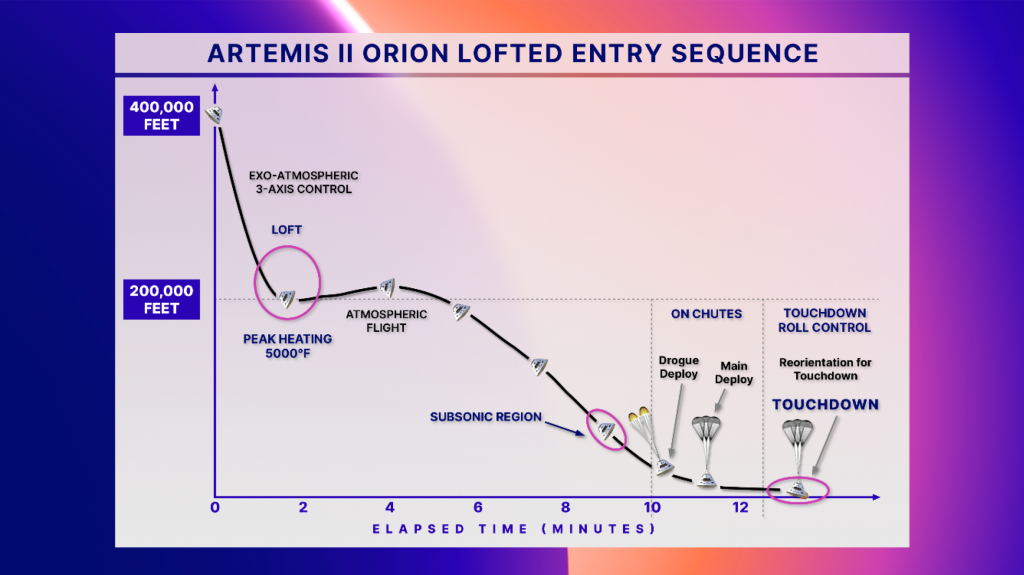
Infographic featuring the Artemis II Orion lofted entry sequence. This graphic was presented by Artemis II Flight Director Rick Henfling during the mission status briefing to the media and public on April 8, 2026 at NASA’s Johnson Space Center in Houston.
NASA
Following atmospheric entry, Orion will deploy a sequence of parachutes, beginning with drogue chutes to stabilize the spacecraft, followed by three main parachutes that will slow the capsule to approximately 20 miles per hour before splashdown. Recovery teams positioned in the Pacific, led by the U.S. Navy in coordination with NASA, are staged to retrieve the crew and spacecraft shortly after landing.
Artemis II serves as the first crewed test flight of NASA’s deep space exploration systems, including the Space Launch System and Orion spacecraft. The mission followed a free-return trajectory around the Moon, allowing the spacecraft to loop around the lunar far side and return to Earth without requiring major propulsion maneuvers in the event of an emergency.
Throughout the mission, engineers have been collecting data on Orion’s life support systems, navigation performance, communications, and crew operations in deep space. Particular attention has been given to validating the spacecraft’s Environmental Control and Life Support System, as well as crew interfaces and manual control capabilities.
The reentry and recovery phase represents one of the most critical tests of the mission. Orion’s ablative heat shield, the largest ever built for human spaceflight, will be evaluated for performance during the high-energy return from lunar distances. Data gathered during this phase will inform future missions, especially those involving extended stays and more complex flight profiles.
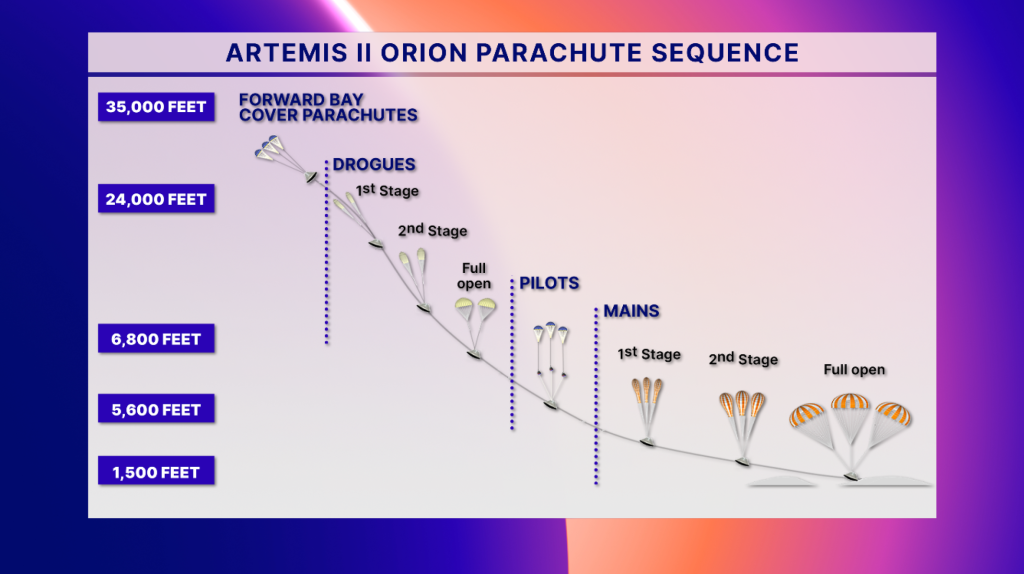
Infographic displaying the Artemis II Orion parachute sequence. This graphic was presented by Artemis II Flight Director Rick Henfling during the mission status briefing to the media and public on April 8, 2026 at NASA’s Johnson Space Center in Houston.
NASA
The successful completion of Artemis II will provide NASA with the certification data needed to proceed with subsequent missions in the Artemis program. While earlier plans outlined a rapid return to the lunar surface, the agency’s current roadmap focuses on refining landing systems and developing infrastructure required for sustained human operations on the Moon.
Recovery operations are expected to conclude within hours of splashdown, with the crew undergoing initial medical evaluations aboard recovery vessels before being transported back to shore. The Orion capsule will also be secured for post-flight analysis, where engineers will examine systems performance in detail.
With splashdown imminent, Artemis II stands on the verge of completing a mission that reestablishes human capability to travel beyond low Earth orbit. The data collected during reentry and recovery will play a key role as NASA prepares for the next phase of its lunar exploration campaign.