
NASA Outlines First Moon Base Missions, Awards Lunar Rover and Lander Contracts
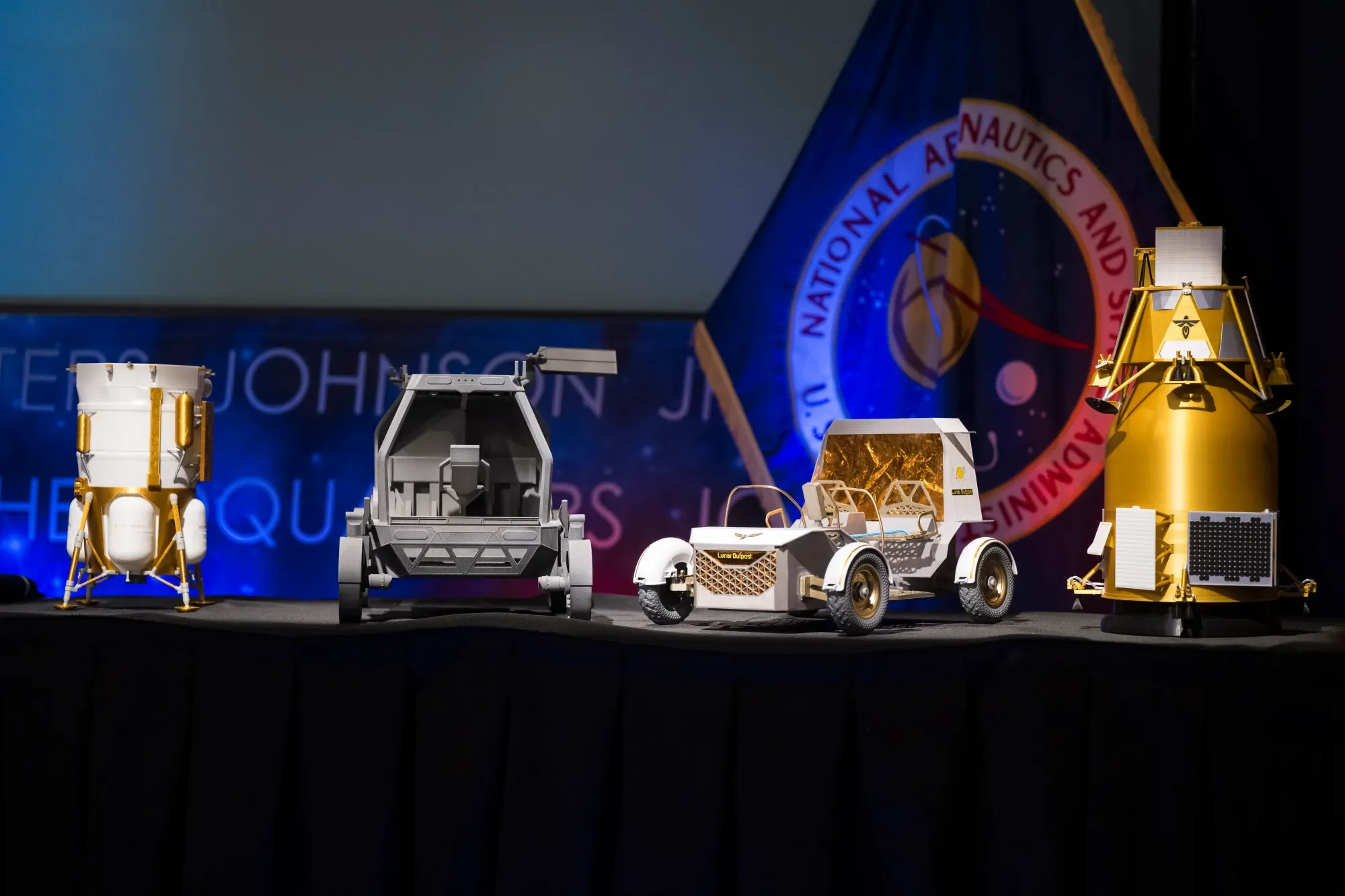
From left to right, models of the Blue Origin Mark 1 Lunar Lander, Astrolab Crewed Lunar Rover, Lunar Outpost Pegasus rover, and the Firely Elytra Dark orbiter are seen at the conclusion of a news conference to discuss Moon Base, a long-term lunar exploration and infrastructure initiative designed to enable sustained human presence and expanded scientific and commercial activity at the lunar South Pole, Tuesday, May 26, 2026, at the Mary W. Jackson NASA Headquarters building in Washington.
Credit: NASA/Aubrey Gemignani
WASHINGTON — NASA has announced a new round of lunar exploration missions, rover contracts and lander awards aimed at building the early infrastructure for sustained operations at the Moon’s South Pole, a major step in the agency’s broader Artemis campaign.
The update, announced Tuesday at NASA Headquarters, outlined the first three “Moon Base” missions, new Lunar Terrain Vehicle task orders, and upcoming commercial lander opportunities intended to reduce risk before astronauts return to the lunar surface. NASA said the missions are designed to build operational experience through a combination of robotic cargo deliveries, surface mobility demonstrations and science payloads.
The first mission, Moon Base I, is targeted for launch no earlier than fall 2026. It will use Blue Origin’s Blue Moon Mark 1 Endurance lander to deliver NASA payloads to the Shackleton Connecting Ridge, a region near the lunar South Pole. The payloads include the Stereo Cameras for Lunar Plume-Surface Studies instrument, which will examine how landing thrusters interact with lunar soil, and a Laser Retroreflective Array to help spacecraft more precisely determine their location using reflected laser light.
NASA said the mission is intended to demonstrate capabilities that could reduce risk for future Artemis landing operations. The South Pole region is a focus for NASA and its partners because of its challenging terrain, lighting conditions and potential access to resources that could support longer-duration surface activity.
Moon Base II is planned for launch later this year aboard Astrobotic’s Griffin lander. The mission will carry more than 1,100 pounds of cargo, including Astrolab’s FLIP rover, to help mature mobility systems that could inform future Lunar Terrain Vehicle operations. A third mission, Moon Base III, is also targeted for this year and will carry Lunar Vertex, the first payload selected through NASA’s Payloads and Research Investigations on the Surface of the Moon initiative. That mission will fly on Intuitive Machines’ Nova-C Trinity lander and study lunar swirls, the bright surface markings that may help scientists better understand how the Moon’s surface changes over time.
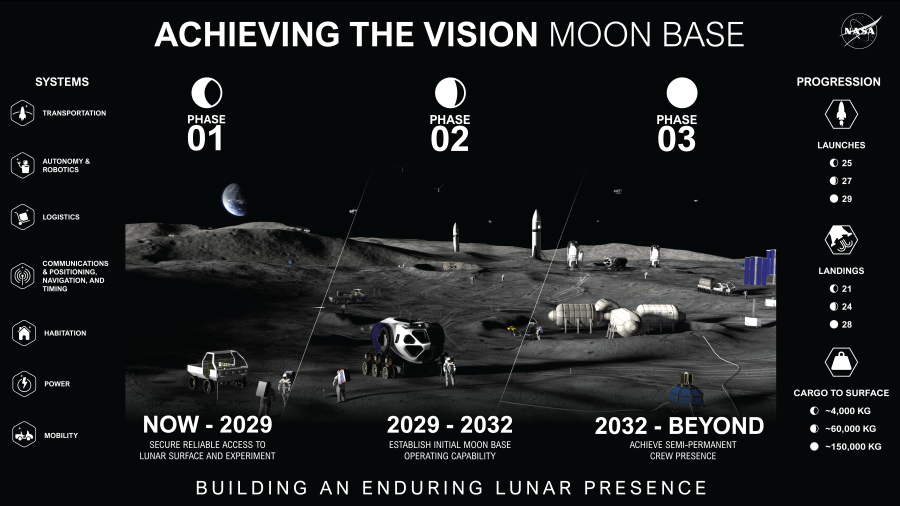
Moon Base timeline provided by NASA.
The agency also awarded Astrolab $219 million and Lunar Outpost $220 million under the first phase of the Lunar Terrain Vehicle Services contract. The vehicles are intended to support both crewed and uncrewed operations on the lunar surface by 2028 through NASA’s Commercial Lunar Payload Services program. Astrolab’s crewed rover is based on its FLEX architecture, while Lunar Outpost’s Pegasus rover is designed for manual, autonomous and teleoperated driving.
NASA also awarded Blue Origin $188 million, with an option period worth $280.4 million, for task orders tied to delivering rovers to the Moon’s South Pole region. The agency said the work falls under its CLPS framework, which uses commercial providers to deliver NASA science and technology payloads to the lunar surface and lunar orbit.
For Florida’s spaceflight community, the announcement adds context to the work already underway at Kennedy Space Center, where NASA’s Space Launch System, Orion spacecraft and Exploration Ground Systems remain central to the Artemis architecture. NASA says Artemis III will launch crew aboard Orion on SLS from Kennedy Space Center in Florida, continuing the agency’s step-by-step buildup toward future lunar surface missions.
NASA also provided an update on MoonFall, a Jet Propulsion Laboratory-led mission that will send four small drones to make short hops across the lunar surface while surveying potential Artemis landing sites. Firefly Aerospace has been selected to build the spacecraft that will transport the drones from Earth orbit to the Moon, with launch targeted for 2028.
NASA said more CLPS awards and Moon Base payload selections are expected in the coming weeks and months. Those missions will continue to shape the agency’s early lunar infrastructure campaign as Artemis moves from test flights and demonstrations toward longer-duration human operations on the Moon.