
SpaceX Targets April 27 for Next Falcon Heavy Launch from Kennedy Space Center
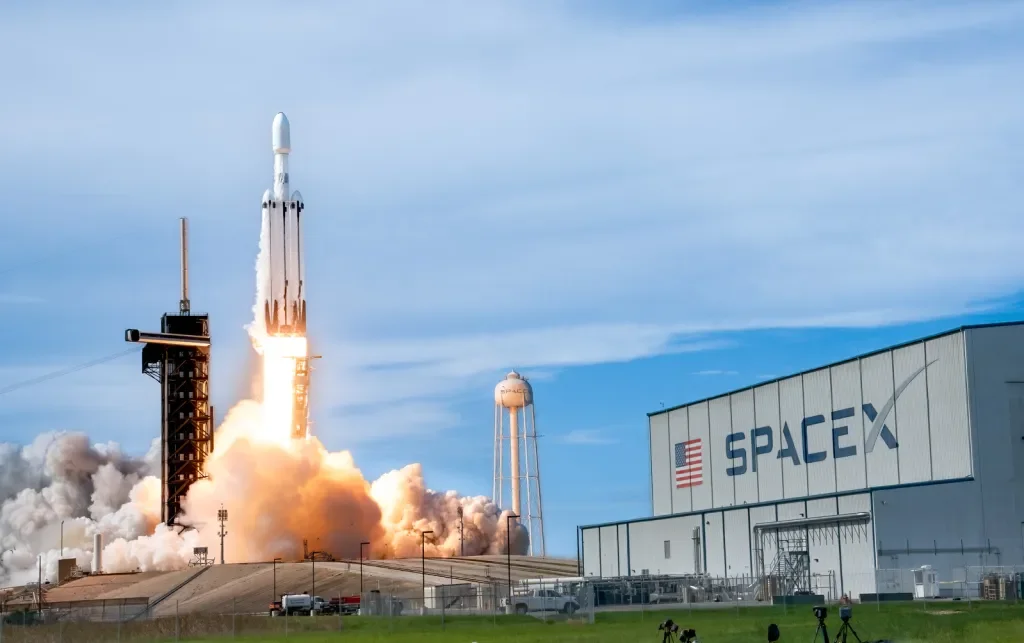
SpaceX Falcon Heavy rocket during liftoff. Photo: SpaceX
Cape Canaveral, Florida — SpaceX is preparing for its next Falcon Heavy launch from Kennedy Space Center, with liftoff currently scheduled for next Monday. The mission will mark another flight of the company’s most powerful operational rocket, continuing a steady cadence of heavy-lift launches from Florida’s Space Coast.
The launch is set to take place from Launch Complex 39A, a historic pad that has supported missions ranging from Apollo to the Space Shuttle program. In recent years, SpaceX has modified the site to support both Falcon 9 and Falcon Heavy operations, making it a central hub for the company’s launch activities.
Falcon Heavy is composed of three Falcon 9 first-stage boosters strapped together, generating more than 5 million pounds of thrust at liftoff. The configuration allows the vehicle to carry significantly heavier payloads than a standard Falcon 9, enabling missions to higher-energy orbits and deep space destinations.
While specific details about the payload for this mission have not been fully disclosed, Falcon Heavy is typically used for national security missions, large commercial satellites, and interplanetary spacecraft. The rocket’s ability to deliver payloads to geostationary transfer orbit or beyond makes it a key asset for customers requiring higher performance than medium-lift vehicles can provide.
As with previous Falcon Heavy missions, SpaceX is expected to attempt recovery of the side boosters. These boosters separate from the core stage a few minutes into flight and perform controlled descents back to landing zones at Cape Canaveral Space Force Station. The center core, depending on mission requirements, may attempt a landing on a droneship positioned in the Atlantic Ocean.

ViaSat-3 F3 is expected to cover the Asia-Pacific (APAC) region.
Rendering: ViaSat
The upcoming launch continues SpaceX’s ongoing efforts to demonstrate reliability and reusability across its fleet. Falcon Heavy first flew in 2018 and has since been used for a limited number of high-profile missions, including payloads for the U.S. Department of Defense and NASA. Each launch contributes additional data on booster performance, recovery operations, and upper stage capabilities.
The mission also underscores Florida’s role as a primary launch site for U.S. space operations. With both government and commercial providers operating from Cape Canaveral and Kennedy Space Center, the region remains one of the busiest spaceports in the world.
In the lead-up to launch, SpaceX teams will complete final integration and testing of the vehicle, including static fire testing of the rocket’s engines and payload encapsulation. Weather conditions will also be closely monitored, as Florida’s spring patterns can introduce variability in launch windows.
If successful, the mission will add to Falcon Heavy’s growing track record and further solidify its role in supporting high-mass and high-energy missions. It also comes at a time of increased competition in the heavy-lift market, as other providers continue developing and testing new launch vehicles.
Looking ahead, SpaceX is expected to continue flying Falcon Heavy for select missions while advancing development of its next-generation Starship system. In the near term, however, Falcon Heavy remains a critical component of the company’s launch capabilities, particularly for missions requiring proven performance and high payload capacity.