
NASA’s Roman Space Telescope Arrives in Florida Ahead of Launch
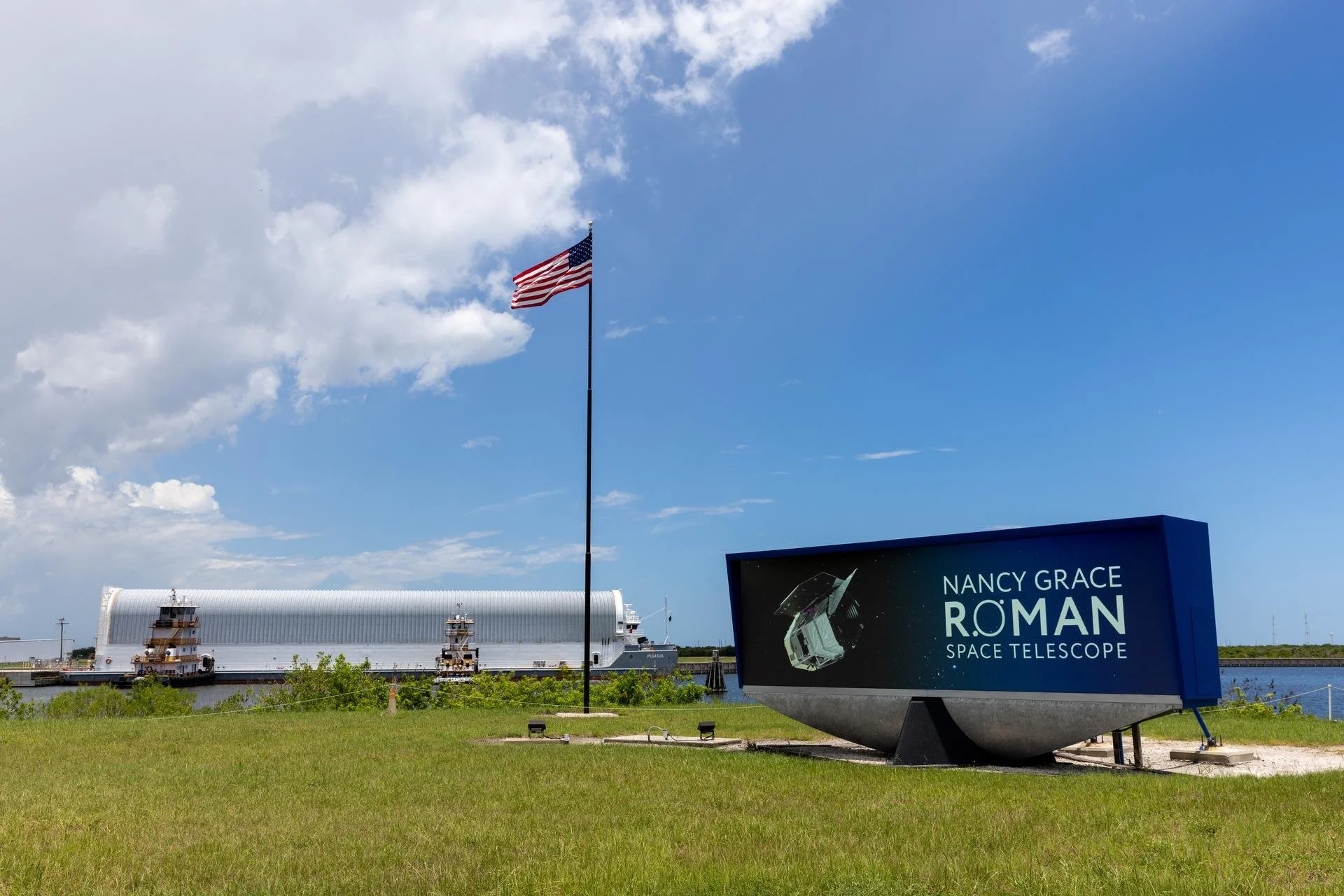
NASA’s Pegasus barge arrives at the Launch Complex 39 turn basin at the agency’s Kennedy Space Center in Florida carrying NASA’s Nancy Grace Roman Space Telescope on Sunday, June 21, 2026.
Cape Canaveral, Florida — NASA’s Nancy Grace Roman Space Telescope has arrived in Florida, marking a major step toward launch for the agency’s next flagship astrophysics observatory.
The telescope, designed to survey the universe in infrared light with a field of view far wider than the Hubble Space Telescope, is now entering final launch processing ahead of its planned liftoff from Florida’s Space Coast. Roman is scheduled to launch on a SpaceX Falcon Heavy rocket, adding another high-profile NASA science mission to Florida’s growing manifest of deep-space and astrophysics launches.
Roman is one of NASA’s most significant space observatories of the decade. The mission is designed to study dark energy, map the large-scale structure of the universe, search for exoplanets, and demonstrate advanced technologies for directly imaging planets beyond the solar system.
The observatory’s arrival in Florida begins the final phase of ground processing before it is encapsulated inside its payload fairing and integrated with the launch vehicle. That work typically includes post-transport inspections, functional testing, fueling or servicing operations where required, and final closeouts before the spacecraft is turned over for launch integration.
The Roman Space Telescope carries a 2.4-meter primary mirror, the same size as Hubble’s, but its Wide Field Instrument will allow it to capture much larger portions of the sky in a single observation. NASA says that wide-field capability will allow Roman to produce enormous surveys of galaxies, stars, and planets with a speed and scale not possible with earlier observatories.
A major part of Roman’s science program will focus on dark energy, the still-unexplained force associated with the accelerating expansion of the universe. By measuring the distribution and evolution of galaxies across cosmic time, Roman is expected to help astronomers refine their understanding of how the universe has changed over billions of years.
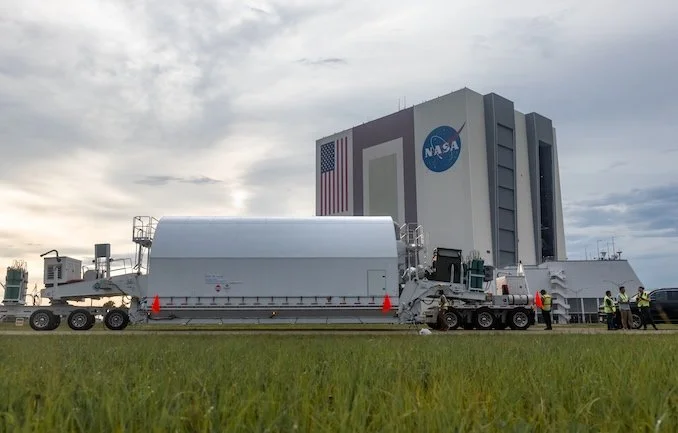
The telescope will also conduct a major exoplanet survey using gravitational microlensing, a technique that detects planets by measuring how their gravity bends and magnifies light from background stars. That approach is expected to help scientists find planets at greater distances from their stars than many of the worlds detected by other methods, offering a broader view of planetary systems across the galaxy.
Roman will also carry a Coronagraph Instrument, a technology demonstration intended to block the glare of stars and improve the ability to directly observe faint planets orbiting nearby stars. While not the mission’s primary science instrument, the coronagraph is an important step toward future observatories designed to image Earth-like planets around other stars.
For Florida, Roman’s arrival continues a steady flow of major NASA payloads moving through the state’s launch infrastructure. The mission joins a manifest that includes crewed flights, cargo missions, planetary spacecraft, commercial payloads, and national security launches flying from Kennedy Space Center and Cape Canaveral Space Force Station.
Roman is named for Nancy Grace Roman, NASA’s first chief of astronomy and a key figure in the development of space-based astronomy. Often called the “mother of Hubble,” Roman helped lay the groundwork for the observatories that changed scientists’ understanding of the universe.
With the telescope now in Florida, NASA and its launch partners will move through final processing milestones leading up to launch. The next major steps are expected to include spacecraft checkouts, payload encapsulation, integration with the Falcon Heavy rocket, and a launch readiness review before the mission departs the Space Coast.